Positions Through Essaying
At the beginning of Unit Two, I returned to a moment I hadn’t finished with.
Masculinity.
I wanted to bend it — literally.
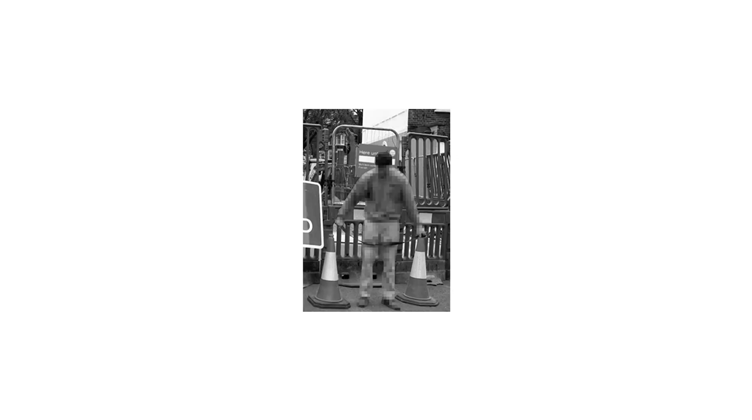
Starting where I left off: the construction site.
But this time, a man in white-collar uniform.
A belt — stiff, loaded — morphs into softer, stranger forms.
A quick experiment. A quiet rebellion.
One hundred frames. One hundred small shifts.
But what does it mean to bend masculinity without breaking it?
What happens when the object that holds you together becomes fluid?
I turned to Sonder by Adam Lin.
An affectionate portrait of men in quiet, domestic spaces.
Here, masculinity wasn’t rigid. It was soft. Intimate. Still.
It shifted something in me.
I no longer wanted to observe — I wanted to interfere.
To participate.
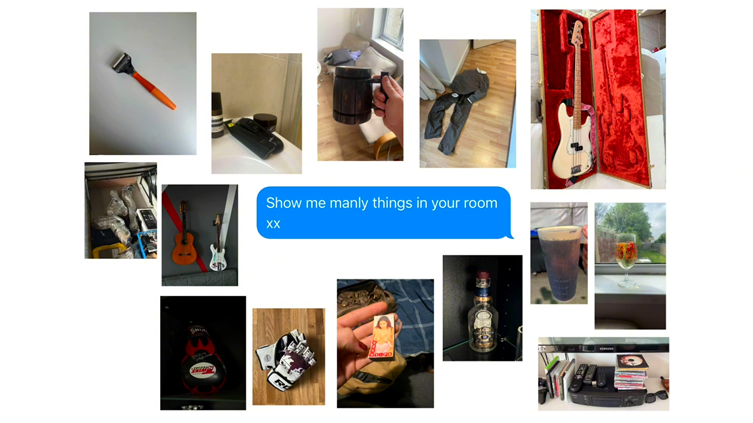
So, I asked men to send me images of what they considered “manly.”
Boobs. Beer. Records. Weapons.
An odd intimacy emerged.
Almost confessional.
But I wasn’t just collecting — I was curating. Framing.
What did it mean that I — a woman — was asking for these?
Was I documenting masculinity? Or exposing it?
I printed the objects onto a shirt.
Almost like a wearable canvas of confession.
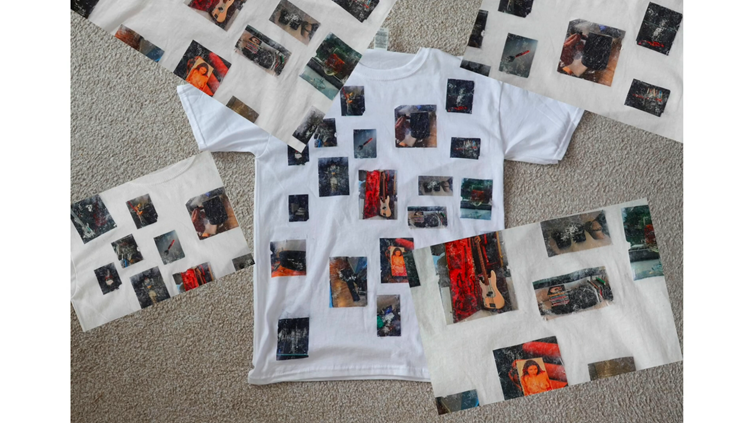
I then wondered:
Was this an archive of masculinity? Or a performance of it?
Was I amplifying these men — or mocking them?
The responses were too broad — as each man had his own definition of masculinity.
So, I narrowed in on one man, to keep the narrative clear.
First, I printed his masculinity onto a shirt.
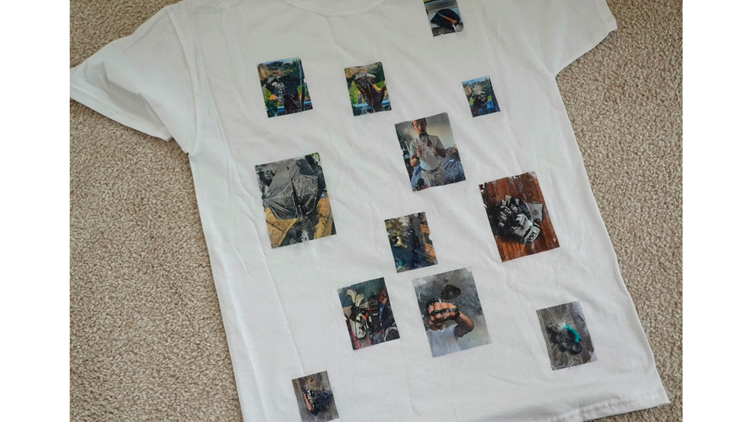
But then I made him wear it.
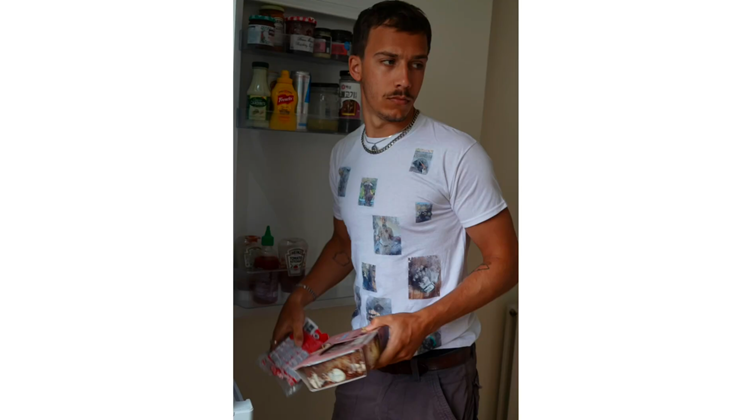
To quite literally put it on.
Suddenly, it wasn’t about the objects anymore —
it was about him inside them.
How the symbols clashed with the softness of being photographed.
Like he was cosplaying his own idea of what a man should be.
What happens when masculinity is turned into costume?
When it stops being lived — and starts being worn?
But something felt incomplete.
I wanted to connect this exploration to something more rooted in my own culture —
So, I turned to the visual language of martyr posters in the Arab world.
One reference stood out to me a 1970s poster of Gamal Abdel Nasser — Egypt’s former president, military hero, and symbol of Arab nationalism —
plastered across the streets of Lebanon.
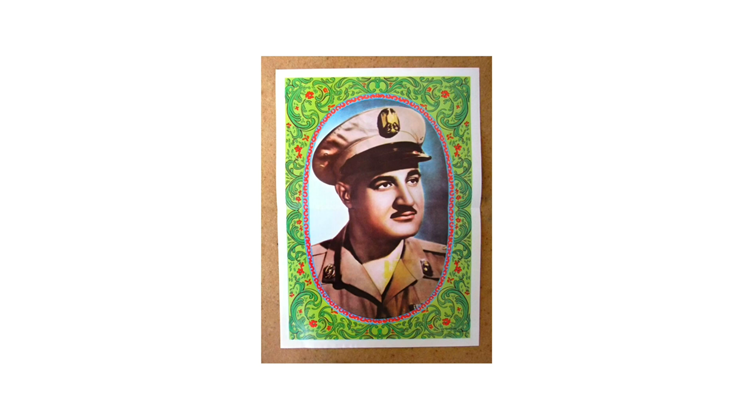
(Braich Posters, 2025)
I started by taking it apart.
Peeling away the frame.
Stripping it down to just him.
What happens when we isolate the man from the myth?
Here’s the original image.
We can tell he was a military man — the uniform gives that away.
But what about the other sides of him?
He was also a father. A writer.
He built the Aswan Dam, nationalized the Suez Canal —
achievements you’d never know just by this portrait.
Why are these parts of his masculinity left out?
Why the oval?
Why not this? Or this?
Why the most ornamental, controlled, untouchable shape?
And what about these versions of him?
Not alone, not heroic — just human.
Surrounded by people. Laughing. Being.
Why are these excluded?
Why is this the face we remember?
Why not at least let him smile?
I began questioning:
Who gets to be in these portraits?
Is it only the fallen? The powerful?
The ones sanctioned by the state — or mourned by the masses?
In Portraits of Resistance, martyr posters are described as
“repositories of memory and mirrors of collective identity.” (Donc Voilà Quoi, 2025)
But if that’s true —
who else is worthy of being remembered this way?
Who else carries memory?
Shapes identity?
So, I tried something else.
I placed my late great aunt inside the frame.
She was everything in our family —
the life of the party, lighting up every room.
A different kind of hero.
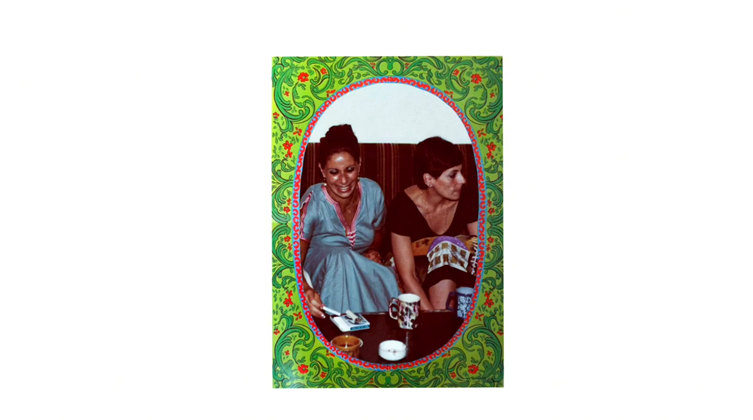
And as I looked at her image —
so full of joy, caught mid-laughter —
I started to think about how we remember.
Who makes that possible?
And then I saw it clearly:
My grandfather, Mohammed.
The man behind the camera.
The quiet observer. The documenter.
He was the one capturing these fragments of us —
these glances, gestures, gatherings.
Memory made visible, again and again.
[You strip the photographs away, leaving only him.]
But we never frame him.
Never spotlight the man who saw all of us,
without asking to be seen himself.
Why does it take loss to be honoured?
Why do we wait for our men to die before calling them worthy?
What about the ones still shaping us — with care, with consistency, with presence?
Maybe it’s time to celebrate the living.
I wanted to reimagine the visual language of martyr posters —
not to mourn the dead,
but to honour the living.
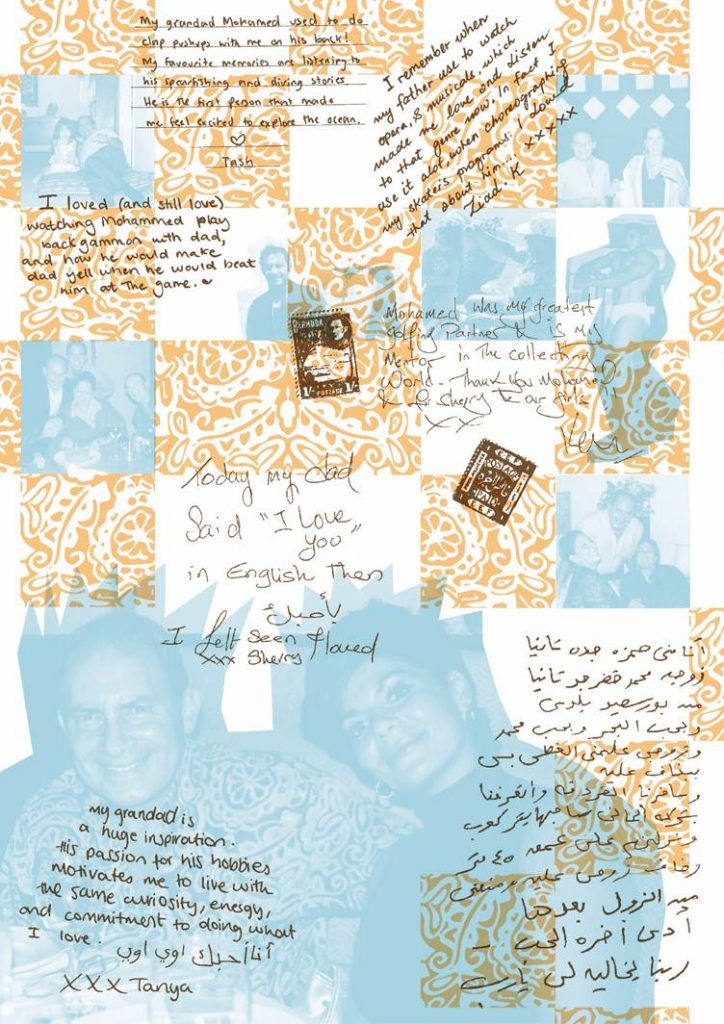
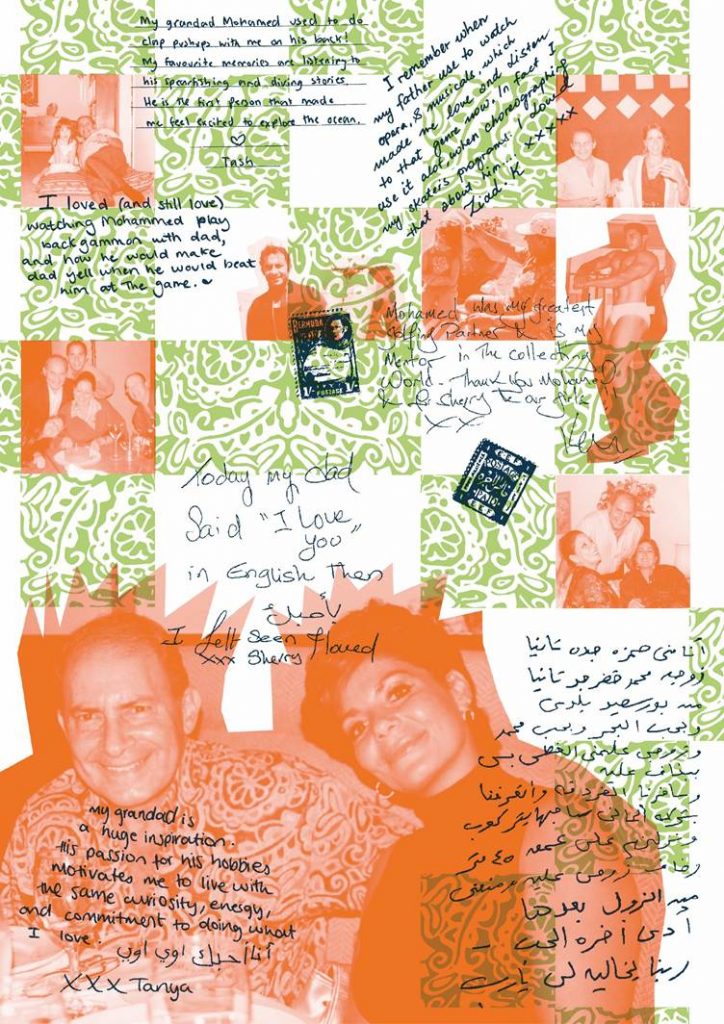
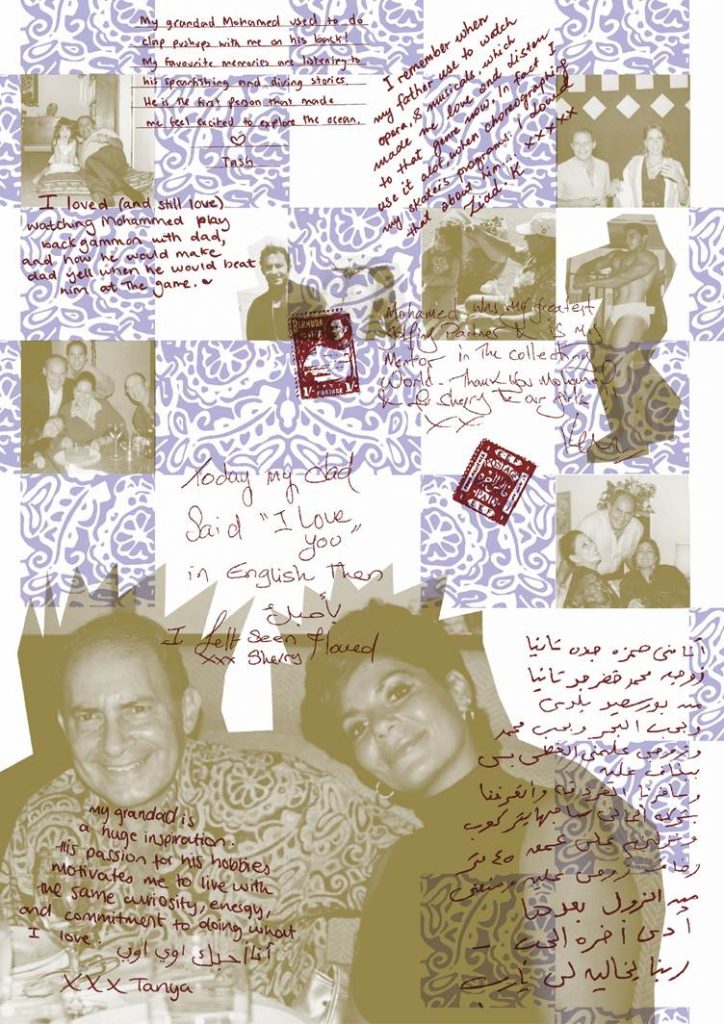
To honour my grandfather, Mohammed.
I began with what he wears best:
his patterned shirts — loud, playful, full of character.
I extracted fragments from them,
treating each square like a keepsake.
A textile archive of his presence.
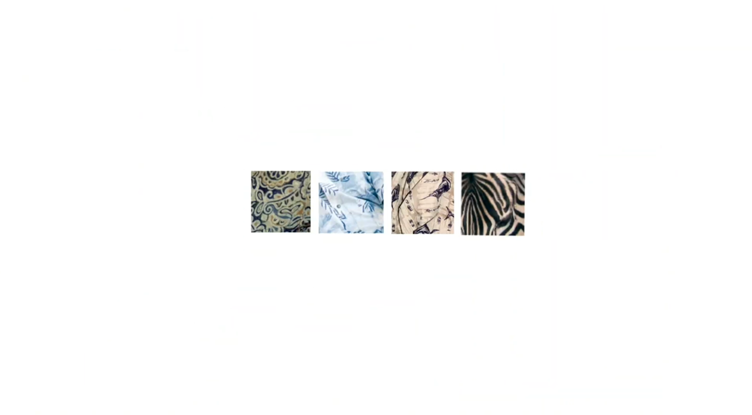
Inspired by Jim Goldberg’s Raised by Wolves (Goldberg, 1995),
I asked my family to write their favourite memory of him.
Tiny love letters.
Handwritten proof that he mattered —
not just to history, but to us.
Instead of building a traditional border,
I scattered these tiles across the page —
like pieces of memory,
drifting but never lost.
The scattered memories converge —
a poster made of many parts,
honouring a man with many layers.
I experimented with colour palettes from The Dictionary of Colour Combinations (Sanzō Wada and Seigensha, Kabushiki Kaisha, 2010) -carefully selecting tones that could hold together the layers of
family, memory, masculinity, and love:
to stitch the fragments into something whole.
This is just the beginning of a series —
a set of screen-printed posters that will each explore a different facet:
But more than that, they ask:
What if masculinity wasn’t honoured through war and sacrifice —
but through care, memory, and the quiet architecture of family?
Can graphic design reframe masculinity — not as a monument to dominance,
but as a living archive of care, memory, and everyday strength?
More specifically —
What if posters could open space for softer strengths to be seen, shared, and sustained?
And what does it mean for design to celebrate them while they’re still here to see it?
Leave a Reply