Draft 1
While you’re working on your copy, articulate (in writing) the key critical questions that emerge through this exploration. (You can use the prompts found on the first page of this brief as a guide.) Discuss how the project that you’re copying raises these questions and write a proposal for a studio-based experiment that would allow you to explore them further. Bring this first draft to your tutorial on Jan 21. (Word count: approx. 200)
Throughout my exploration of basic joinery, several critical questions emerge:
- What is the significance of the materials used in joinery, and how do these materials influence the function, durability, and aesthetics of a joint?
- Beyond physical materials such as wood, where else can joinery principles be identified?
- How can the visual language of joinery be abstracted or reimagined in non-traditional forms?
- What is the significance of the method used to join two pieces of wood?
- What if joinery was made to gradually wear?
- Can joinery be applied conceptually to digital mediums, such as 3D rendering or virtual spaces, and how might this redefine its purpose or functionality?
Draft 2
Identify a reference from the reading list that you can use as a lens through which to view and analyse your project. Then create a second draft of your writing that advances your enquiry in response to this new context. Bring this second draft to your tutorial on Jan 28. (Word count: approx. 400–500)
In exploring basic joinery, I have uncovered a series of critical questions regarding its material, functional, and conceptual dimensions. Using Charles Jencks and Nathan Silver’s concept of adhocism as articulated in “Adhocism: The Case for Improvisation” (Jencks and Silver, 2013), I aim to deepen this inquiry by considering how joinery can embody principles of adaptability, resourcefulness, and improvisation.
Adhocism emphasizes the creative potential of combining available resources to solve problems or create new forms. Joinery conforms with the traditional notions of rigid planning that this philosophy challenges: it is something that can be “simple or complicated, it can either involve two pieces of wood being nailed or glued together or it can involve the intricate joining of two pieces of wood. Although the primary purpose of joinery is to hold wood together strongly and securely, yet it can also be used in a decorative manner too” (What Is Joinery?, 2018). However, when viewed through the lens of adhocism, joinery could transform from merely a technique of connecting materials to a broader metaphor for improvisational design and hybrid creation.
Critical Questions
- Could unconventional materials, such as found objects or recycled components, push the boundaries of traditional joinery?
- Could joinery’s principles inspire interdisciplinary collaborations, such as blending physical construction with digital modelling, viewing joinery as a system of connections, rather than a singular craft?
- Can joinery in digital spaces, such as 3D modeling in Blender, embody adhocist improvisation? Adhocism celebrates the idea of “making do” with what is available, which in digital spaces could involve utilizing open-source models, adapting pre-existing forms, and experimenting with tools to create “digital joints.”
- Could joinery surpass the technical limits of human craftmanship and gravity through using digital tools? Many joiners use digital tools to replicate joints for planning or printing – but what if these tools were used to create imagined joints that could not be replicated in reality?
Plan
- Material Improvisation: Collect and combine unconventional materials (e.g., found materials, wood, plastic, string, etc.) to create physical joints.
- Digital Assemblage: Use Blender to reinterpret these physical joints digitally. This phase will examine how digital spaces can facilitate improvisation and reconfiguration – especially due to my limited access to the wood workshop.
Conclusion
By integrating the philosophy of adhocism into my exploration of joinery, this project the challenges traditional approaches to materials and methods while opening pathways for innovation. Joinery becomes not only a functional technique but also a dynamic process of improvisation and hybridization, reflecting the essence of adhocist design. This experiment will serve as a foundation for reimagining joinery as a practice that transcends its conventional boundaries, inspiring new possibilities in design and craft.
Bibliography
Jencks, C. and Silver, N. (2013) Adhocism: The Case for Improvisation. Cambridge: MIT Press.
What Is Joinery? (2018) Archway Joinery. Available at: https://www.archway-joinery.co.uk/what-is-joinery/.
Draft 3
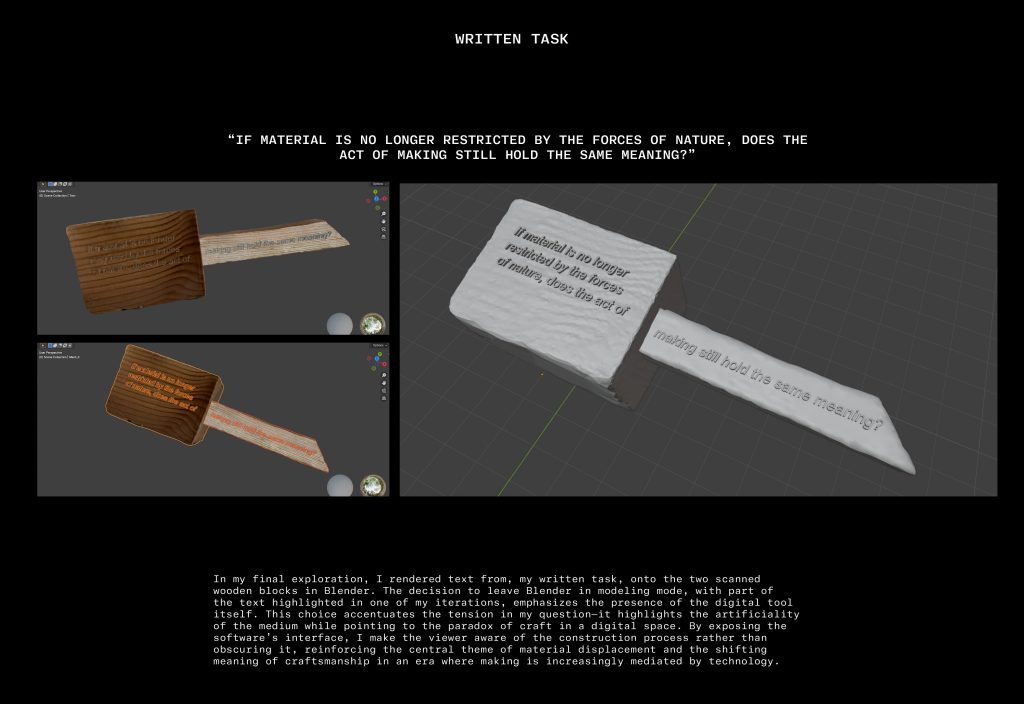
For the third draft of your written response, render your text using the tool or medium that you’ve been exploring during this project. This is both a visual and intellectual exercise. How does the text and its meaning change when you translate it in this way?
Digital Materiality
Joinery is a language of precision, craftsmanship, and function. Traditionally, it is an act of problem-solving, where two wooden pieces interlock through logic, labour, and tactile understanding. But what happens when materiality is displaced, when the constraints of resistance and physical touch are replaced with digital simulation?
Inspired by Exercises in Style by Raymond Queneau, in which the same story is retold in 99 different ways, I constructed 99 digital iterations in Blender using only two scanned wooden pieces as my building blocks. Each structure defies traditional woodworking principles, existing in a space where gravity, friction, and structural logic are irrelevant. They are not crafted in the traditional sense; rather, they are assembled through code and simulation.
By integrating the philosophy of adhocism into my iterative process, this exploration challenges traditional approaches to materials and methods. Joinery becomes a dynamic process of improvisation and hybridization, shifting from a strictly functional practice to one of speculative possibility. These digital experiments serve as a foundation for reimagining joinery as a practice that transcends its conventional boundaries.
Cataloguing
I organized all iterations in a catalogue, as an attempt to bridge the gap between material reality and digital abstraction. I attempt to subvert the conventions of a traditional furniture catalogue to plays with expectations; typically, these catalogues present objects which are functional, tangible, and desirable. In my catalogue, however, the arrangement underscores the alienation of these structures from real-world materiality.
The joinery structures are arranged from what I perceive to be the most possible to the least possible, beginning with forms that could almost be realized in physical wood, and gradually progressing toward structures that exist purely as physical impossibilities.
As the structures progress, the sense of order dissolves. Initially, the compositions align with the structured grid of a traditional furniture catalogue—objects are neatly arranged, suggesting feasibility, familiarity, and an implicit logic. However, as the joinery becomes less restricted by the bounds of logic, this order begins to break down.
This visual shift depicts the departure from material reality. Where traditional joinery is grounded in precision and function, these structures, particular the later, defy those principles, existing only as digital impossibilities. The breakdown of the catalogue format becomes an extension of this resistance—just as these forms reject physical constraints, they also reject the imposed system of order.
Critical Reflection
This project interrogates the boundaries between material reality and digital abstraction. The iterations exist in a space where joinery is no longer bound by material constraints, yet paradoxically, this freedom makes them feel less personal.
There is an inherent contradiction in producing “impossible” joinery—these forms could never exist in real wood without breaking structural logic. Even the intricate, futuristic shapes produced on blender using the “wood” starkly contrasts the nature of the material itself, making the structures both fascinating and alienating.
Ultimately, this study highlights the shifting boundaries between craft, materiality, and digital invention. If joinery is traditionally understood as a negotiation between the maker and material, then this project asks: If material is no longer restricted by the forces of nature, does the act of making still hold the same meaning?
Leave a Reply